
The Complete Balancing Series
Series guide. The balancing series in reading order: six articles from single-plane fundamentals to at-speed balancing of flexible rotors, seven calculators, and the knowledge check, each with a summary and a figure.
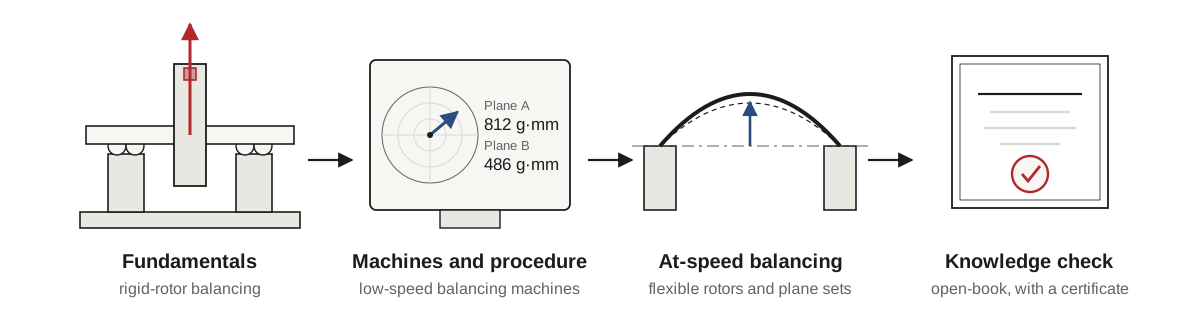
Balancing is the correction of a rotor’s mass distribution so that it turns about its axis of rotation with minimal rotating force at its bearings. This series begins with single-plane, low-speed balancing of rigid rotors and finishes with multi-plane, at-speed balancing of flexible rotors. Calculators are provided along the way to assist understanding and help practitioners with real balancing work. A knowledge check is available at the end for those who want to confirm what they learned.
The articles are free to read. The fundamentals calculators are available to free subscribers, and the advanced calculators and the knowledge check to premium members.
Articles
- Single-Plane Balancing: The FundamentalsArticle
What unbalance is physically, how it is quantified in gram-millimeters and ounce-inches, when a single correction plane is enough, and how the API and ISO tolerance criteria set the residual a rotor may keep. The starting point for every article that follows.
- Two-Plane Balancing: The FundamentalsArticle
The taxonomy of static, couple, dynamic, and quasi-static unbalance, why a couple is invisible to one correction plane, and why two planes are sufficient for any rigid rotor. Introduces the per-plane and static-and-couple forms that the converters use.
- Low Speed Balancing MachinesArticle
The hard-bearing and soft-bearing architectures and the support resonance that divides them; the arbors, drives, transducers, and phase reference between the rotor and the reading; and the metrics that state what a machine can achieve. Read this before the procedure.
- Low Speed Balancing ProcedureArticle
Setting up the rotor and the machine, the measure-and-correct cycle, the correction methods and how a correction is split between available positions, and the residual unbalance verification test that proves the result independently of the machine’s calibration. The shop-floor article of the series.
- At-Speed Balancing: The FundamentalsArticle
Critical speeds and mode shapes, what amplitude and phase do through a critical, and why a two-plane low-speed balance can leave a flexible rotor vibrating heavily at speed. Explains what at-speed balancing accomplishes and why it supplements rather than replaces the low-speed balance.
- At-Speed Balancing: Machines and ProcedureArticle
The vacuum-chamber facilities, the choice of correction planes for flexible rotors, the sequence of an at-speed job, the plane-by-plane influence coefficient method, modal balancing with plane sets, and how an at-speed balance is specified and accepted. The most advanced article in the series.
Calculators
- Balance Tolerance CalculatorCalcSubs
Companion tool to Single-Plane Balancing: The Fundamentals.
Enter the rotor weight, the maximum continuous speed, and the correction radius, and select the API criterion or an ISO grade; the tool reports the allowable residual unbalance, the allowable unbalance mass at your radius, and the rotating force at speed, in US or SI units.
- Two-Plane Unbalance ConverterCalcSubs
Companion tool to Two-Plane Balancing: The Fundamentals.
Converts between the per-plane form and the static-and-couple form of a rigid rotor’s unbalance, in either direction, and names the condition the result describes.
- Pedestal Force ConverterCalcSubs
Companion tool to Low Speed Balancing Machines.
Converts the forces measured at a hard-bearing machine’s two pedestals into the unbalance in two correction planes, and back, from the balancing speed, the pedestal span, and the plane positions.
- Correction Splitting CalculatorCalcPremium
Companion tool to Low Speed Balancing Procedure.
Splits a required correction between two available angular positions and reports the two component masses together with the total the split costs.
- Residual Unbalance Verification CalculatorCalcPremium
Companion tool to Low Speed Balancing Procedure.
Fits the circle through six, eight, or twelve verification readings; reports the verified residual with its calibration scale check and reading scatter; compares it against the tolerance and the machine’s reported residual; and prints a record.
- At-Speed Balancing CalculatorCalcPremium
Companion tool to At-Speed Balancing: Machines and Procedure.
Runs an at-speed balancing job from baseline and trial readings: influence coefficients for up to five planes across probes and speeds, least-squares corrections against the acceptance limits, and trim runs, with autosave and a saved-file record.
- Plane Set CalculatorCalcPremium
Companion tool to At-Speed Balancing: Machines and Procedure.
Determines the proportions of a plane set for a target mode from the plane positions, so that the set moves that mode while adding no net force or moment, and hands the set to the At-Speed Balancing Calculator.
Knowledge check
- Balancing Knowledge CheckTestPremium
Twenty-two auto-scored questions on application, calculation, and judgment across the six articles and seven calculators, open-book with lookup links, with a per-article score breakdown, save and resume, and a printable certificate at 80 percent or better.
Click any figure to enlarge it. The Library lists every article and tool on the site by topic.